Scene 1
0:00
0:00
1Xi'an Jiaotong University 2University of East Anglia 3University of Tokyo
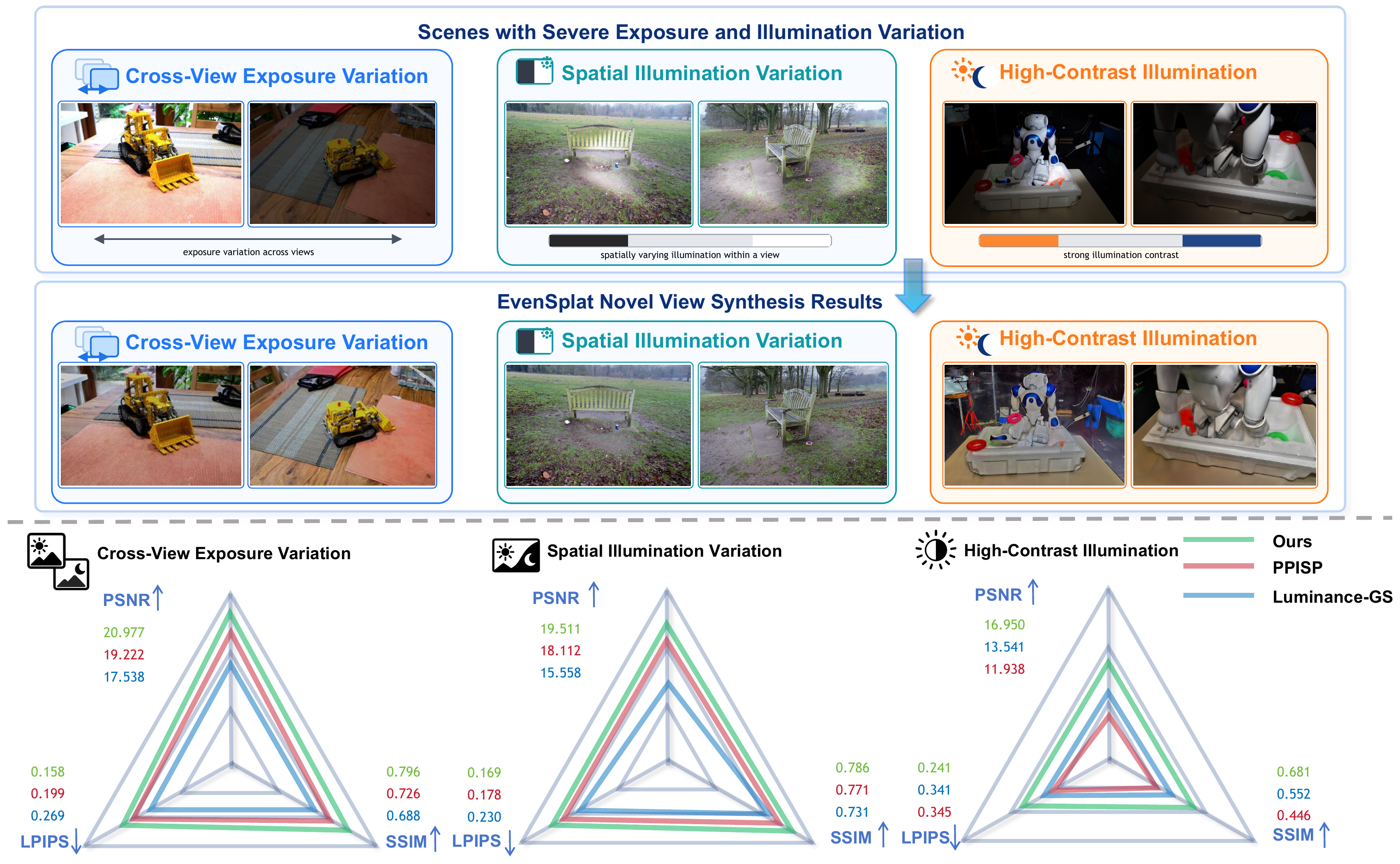
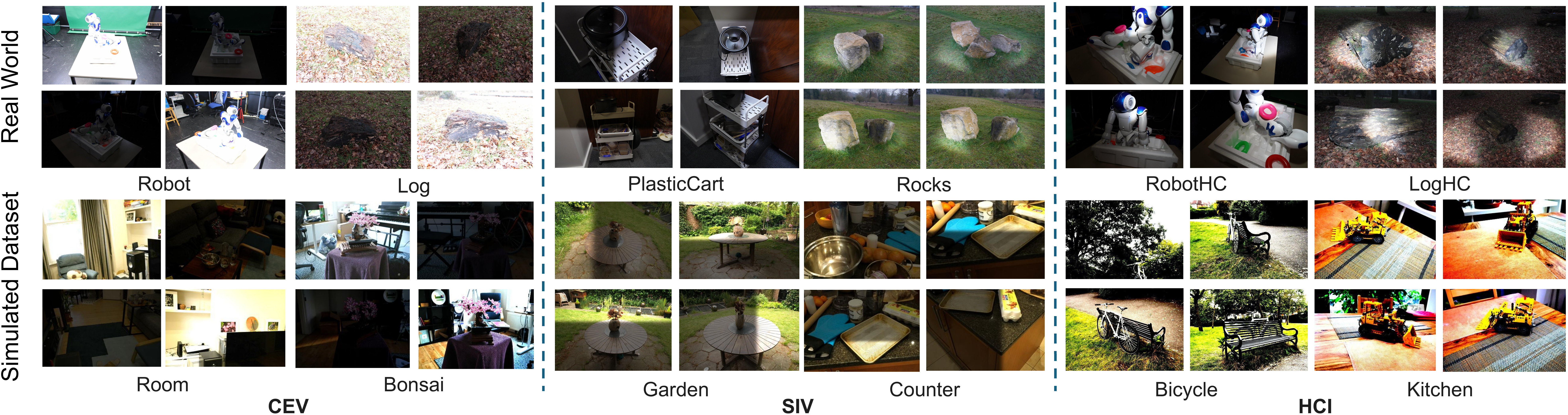
A surface photographed under even light presents nearly the same appearance from every angle; the same surface under uneven light does not. Exposure changes between views, illumination varies within a single image, and locally strong light sources leave one region bright and its neighbor in shadow. Multi-view reconstruction methods such as 3D Gaussian Splatting treat these lighting artifacts as if they were properties of the scene, entangling capture-specific illumination with the geometry and color they recover. We present EvenSplat, a framework that separates the two. EvenSplat couples an image-space illumination decomposition with an illumination field carried by the Gaussians, so that the same explanation of the lighting is shared between the two-dimensional and three-dimensional views of the scene; a camera-response network and a local exposure-compensation module absorb the global and residual differences that remain across training images. Through extensive experiments across multiple datasets and diverse forms of uneven illumination (cross-view exposure, spatial illumination variation, and high-contrast lighting) on both real-world captured and simulated benchmarks, EvenSplat generally outperforms state-of-the-art methods, particularly under high-contrast illumination.
Novel view synthesis (NVS) results under challenging lighting conditions, including cross-view exposure variation (CEV), spatial illumination variation (SIV), and high-contrast illumination (HCI). Up: 3D Gaussian Splatting. Bottom: Our proposed EvenSplat.
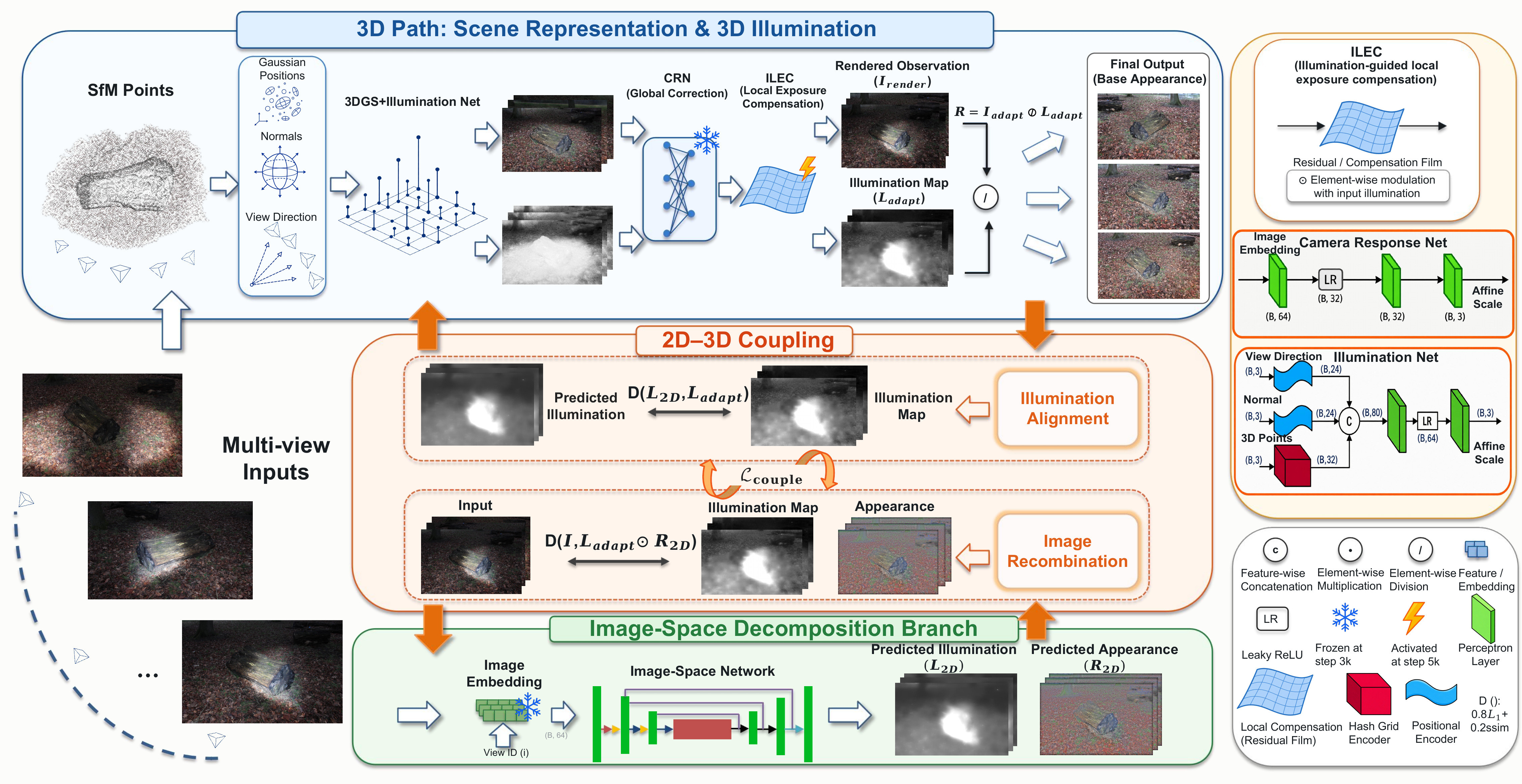
EvenSplat couples image-space decomposition with Gaussian-level illumination. Illumination alignment and image recombination connect the branches. CRN and ILEC absorb global and spatial training-image residuals. Base appearance is distinguished from the observation-fitting path.
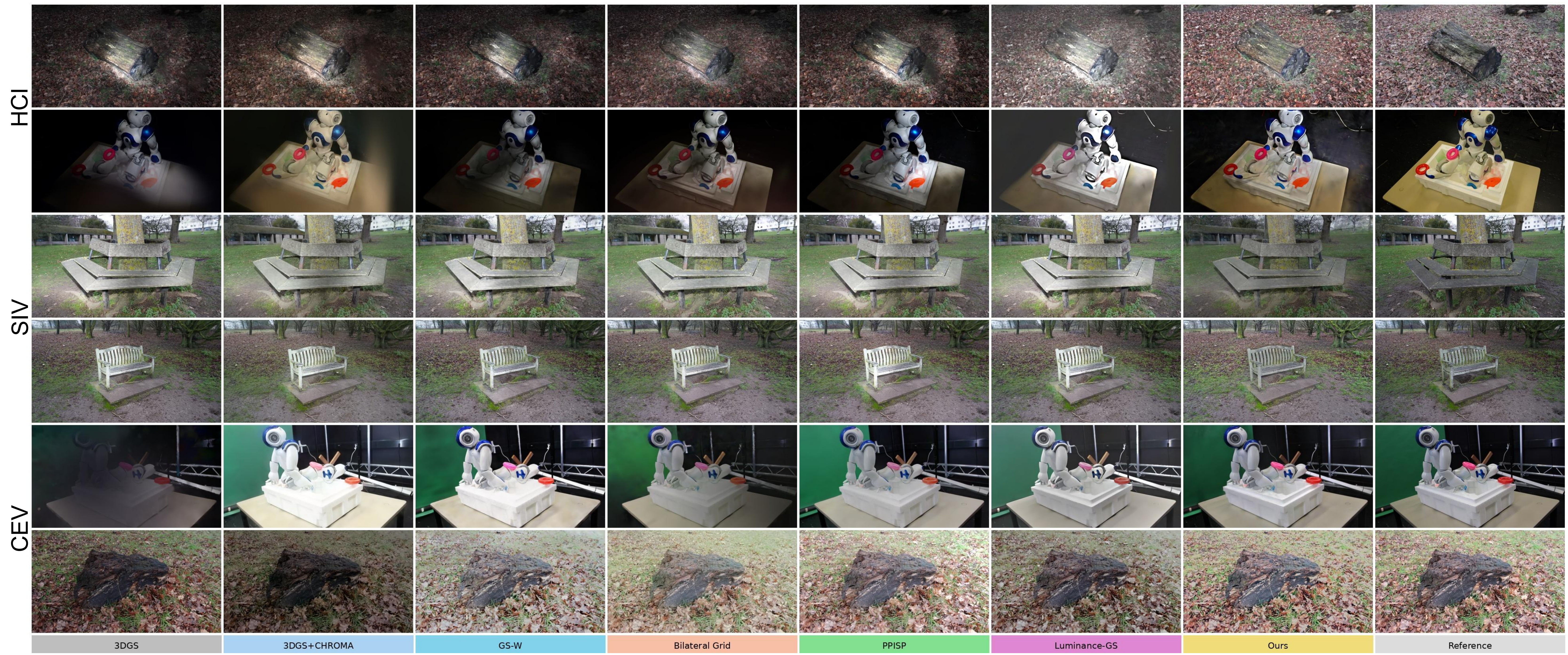
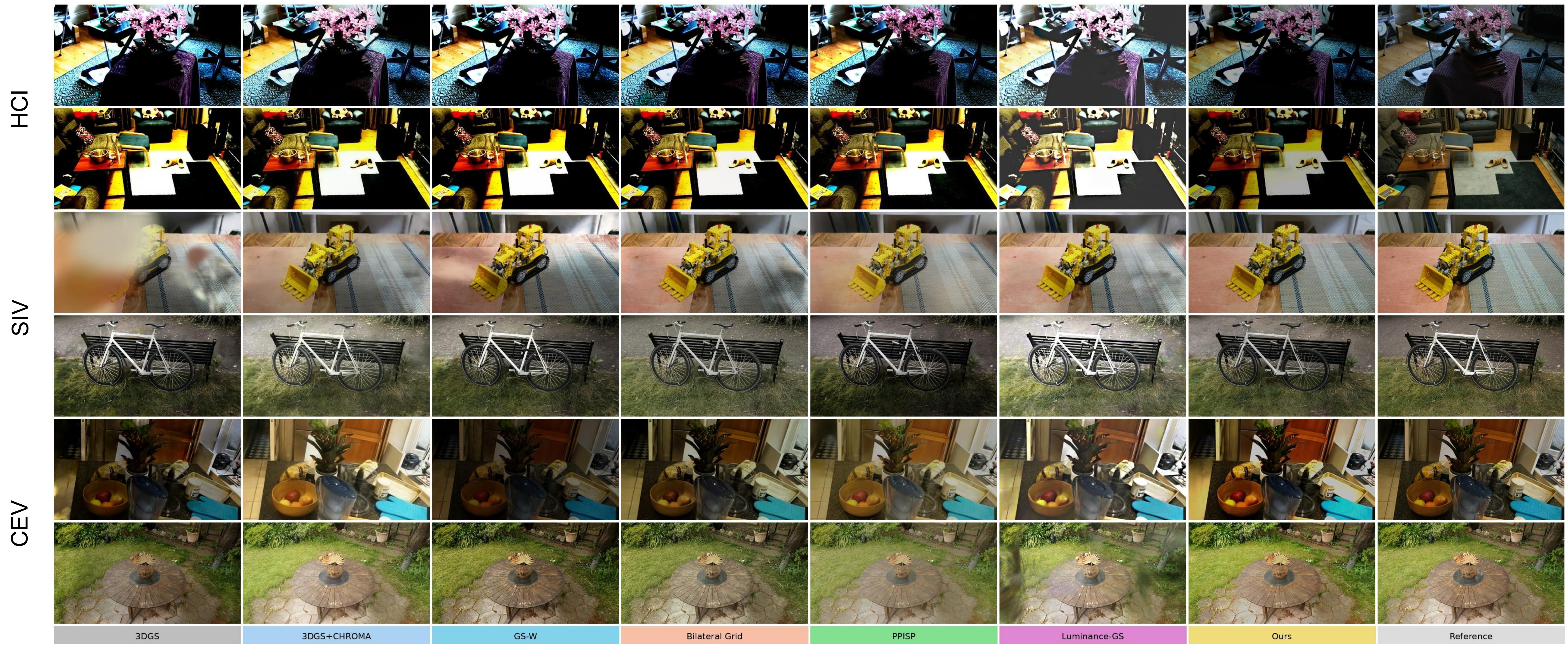
Real-world comparisons. Columns show 3DGS, 3DGS+CHROMA, GS-W, Bilateral Grid, PPISP, Luminance-GS, EvenSplat, and the captured reference. Rows 1–2 show HCI, rows 3–4 SIV, and rows 5–6 CEV. EvenSplat most clearly separates appearance from illumination in the spatially uneven HCI and SIV.
Simulated HCI, SIV, and CEV comparisons. EvenSplat reduces illumination leakage while retaining scene texture; HCI remains the most challenging setting because contrast amplification clips information.